
Property valuation. See what drives the number.
Turnand property financials into a valuation you can explain.
Understanding property value
A value is only as useful as its explanation.
Property valuation is an estimate of a property’s value for a stated purpose and date. Owners use it to explore a sale or refinance; buyers use it to assess a price; brokers use it to support a pricing discussion. The relevant evidence depends on the property, its use, and the market. An asking price alone does not establish value.
Understand property valuation through income, comparable evidence, and explicit assumptions. Explore valuation methods, automated models, and a worked property value example.
How Cactus helps
From property documents to an explained value.
Cactus focuses on document-based valuation for multifamily and self-storage. Our workflow brings income and expense analysis, market context, and editable assumptions together so investors and brokers can explain the value they adopt.
Establish the income you can support.
Use the rent roll, T-12, offering memorandum, and financial statements to understand occupancy, collected income, and operating costs. Keep source periods visible and explain any adjustments before choosing the NOI for an income-based valuation.
Review the market context.
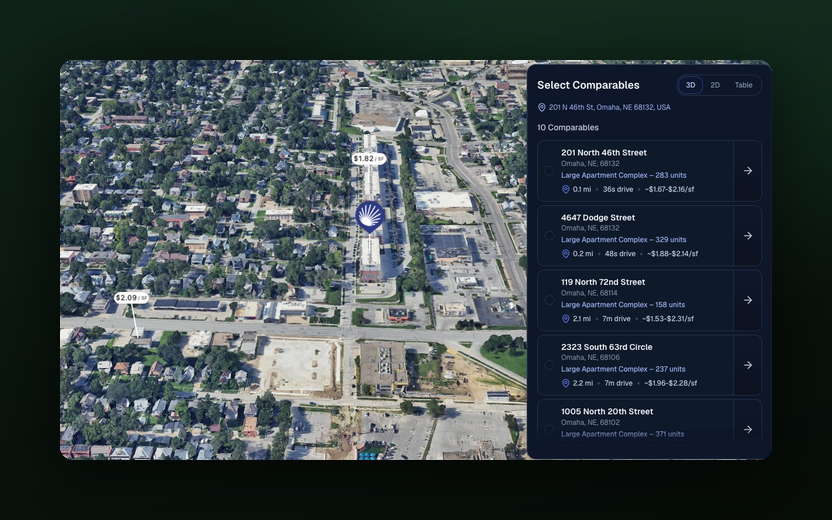
Inspect available comparable evidence and identify where it falls short. Rental comparisons can inform rent assumptions; completed sales can inform a pricing discussion. Location, condition, property type, and timing affect how useful each comparison is.
Explain a range, not just one figure.
Review how changes in NOI and the assumed cap rate affect property value. Show the base case beside alternatives, record the rationale, and flag missing evidence. Share the reviewed financial analysis or export it to Excel.
Property valuation methods
Different properties. Different lenses on value.
Sales comparison approach
Compare the property with recent sales of similar properties and account for differences in location, condition, size, and features. This approach depends on relevant transaction evidence, rather than asking prices alone.
Income approach
Connect the property’s expected income with value. Direct capitalization divides NOI by a supported capitalization rate; a discounted cash flow analysis considers income and an exit over time. This lens is especially relevant to income-producing properties.
Cost approach
Consider the land value and the current cost of replacing the improvements, less depreciation. It provides a different perspective when comparable sales or income evidence is limited. Physical condition and obsolescence matter to the result.
A worked income-approach example
From a T-12 to a property value range.
Suppose a multifamily T-12 reports $1.2 million of revenue and $600,000 of operating expenses. After reconciliation with the rent roll, the team adopts $600,000 of annual NOI. Holding that NOI constant, three assumed cap rates produce the values below. The cap rates are illustrative, not current market observations.
| Report line | Calculation | Result |
|---|---|---|
| Reviewed income | $1.2M revenue − $600k expenses | $600,000 NOI |
| Lower cap-rate scenario | $600,000 ÷ 5.5% | $10,909,091 |
| Base scenario | $600,000 ÷ 6.0% | $10,000,000 |
| Higher cap-rate scenario | $600,000 ÷ 6.5% | $9,230,769 |
| Expense sensitivity at 6% | $550,000 NOI ÷ 6.0% | $9,166,667 |
These are sensitivity scenarios, not a statistical confidence interval. A $50,000 increase in annual expenses reduces the base value by about $833,333. The report should identify the NOI period, adjustments, cap-rate rationale, and missing comparable evidence before a reviewer adopts a value.
Common questions
Property valuation, explained.
What is an automated valuation model?
An automated valuation model (AVM) estimates property value from data and model assumptions. The inputs and coverage vary by model. Cactus supports document-based CRE valuation within its underwriting workflow: review NOI, inspect available market evidence, and see how assumptions affect value. It is not an address-only home-price estimate.
Which properties does Cactus support today?
Our current focus is multifamily and self-storage. Property valuation is a broader subject that includes residential homes and other commercial properties, but the methods explained here are educational context, not a claim that Cactus offers every property type or appraisal method.
What information do I need for an income-based valuation?
Bring a current rent roll, T-12, offering memorandum, and supporting financial statements in PDF, Excel, or CSV. Check reporting periods, collected income, vacancy, concessions, and operating expenses. Identify unusual items and missing periods, and document the basis for any adjustments or assumed cap rate.
How is property valuation different from underwriting?
Valuation asks what a property is worth on a stated basis. Underwriting asks whether a particular investment works at a purchase price, financing structure, and set of operating assumptions. Property value informs underwriting; a buyer’s projected IRR also depends on leverage, cash flows, costs, and the hold period.
How should I check a valuation estimate?
Reconcile extracted figures with the source documents, check the NOI period and adjustments, and review the relevance and dates of comparable evidence. Test alternative income and cap-rate assumptions. Document quality and missing evidence affect the result, so we do not publish a universal accuracy percentage.
Is this an independent appraisal or a guaranteed sale price?
No. Cactus helps prepare a reviewable financial analysis. A model estimate depends on the documents and assumptions supplied, and a transaction price can differ. Where an independent appraisal is needed, the model can support preparation and review; it does not replace that appraisal.
The reading room
Go deeper into property valuation.
Valuation for Commercial Property using cap rate, DCF, sales comparisons, and lease analysis to avoid costly investment mistakes.
Commercial Real Estate Valuation Methods: Which Tells the Truth?Compare Commercial Real Estate Valuation Methods and learn which approach delivers the most accurate property value insights.
How to Calculate Cap Rate on Commercial Property (A Simple Guide)How to calculate cap rate on commercial property using net operating income and market value. Learn the formula, cap rate calculation, and real estate returns.
Ready to connect property value to financing and buyer returns?
Explore CRE underwriting →Bring a property and a pricing question.
See how Cactus connects your property documents, income assumptions, and valuation.
Book a demo